


About FBA UEF
1. Overview
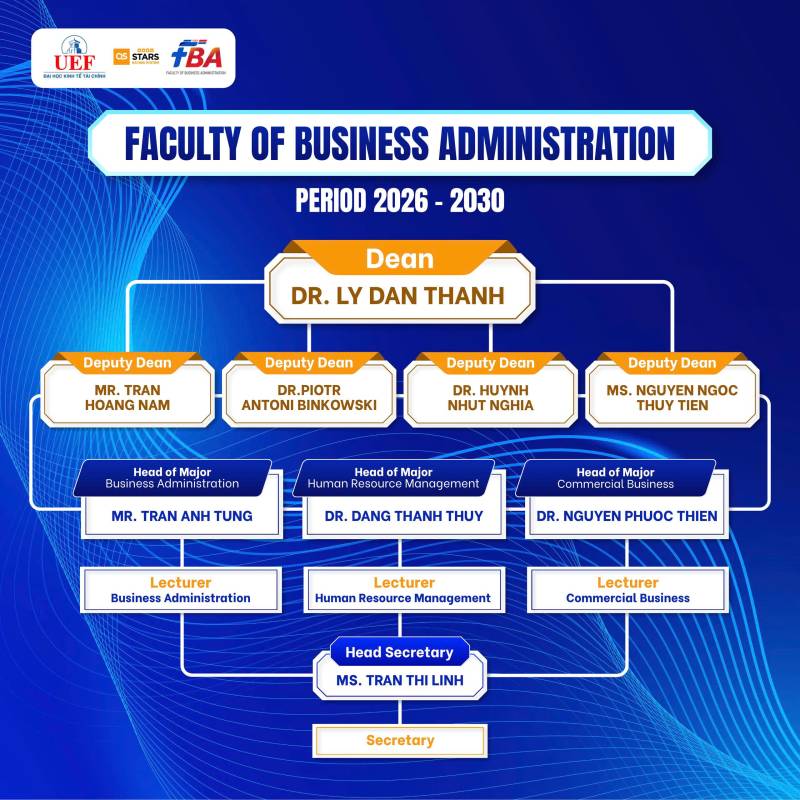
The Faculty of Business Administration is a core academic unit within the Business and Management discipline of Ho Chi Minh City University of Economics and Finance (UEF). Currently, the Faculty directly manages and delivers three key programs: Business Administration, Human Resource Management, and Commercial Business. Aligned with the University’s strategic development orientation for the period 2026–2030, the Faculty of Business Administration orients all its activities based on the University’s strategic pillars, including comprehensive internationalization, digital transformation, enhancement of scientific research, strengthening corporate partnerships, and community service.
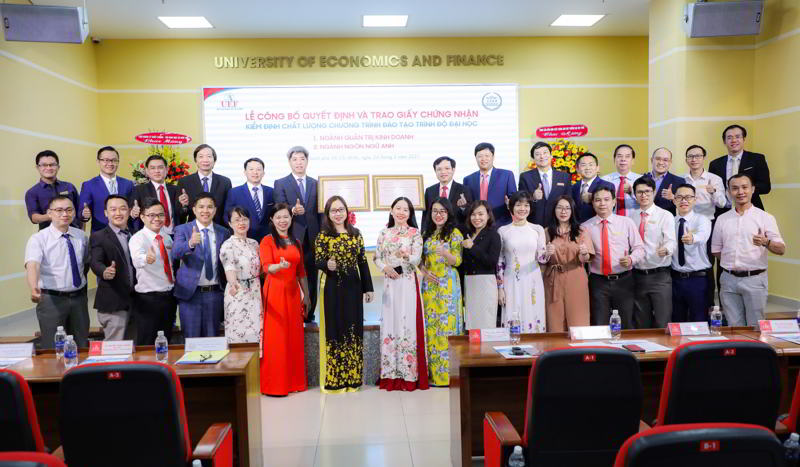
The Faculty’s academic activities are designed with an application-oriented approach, closely aligned with the philosophy of Holistic Education – Lifelong Learning. The Faculty continuously reviews and improves its academic programs while innovating teaching methodologies to meet the Higher Education Institution Standards and rigorous accreditation requirements at both national and international levels (ACBSP, FIBAA, QS Stars). To realize these objectives, the Faculty places strong emphasis on developing a dynamic, innovative, and multicultural learning environment. It regularly organizes scientific research activities, promotes knowledge transfer, and implements community service and volunteer projects with a strong sense of social responsibility.
In the context of a stable and steadily growing student population, the Faculty of Business Administration continuously enhances the quality of its foundational resources. The Faculty’s academic staff is experiencing significant growth in terms of the proportion of doctoral degree holders, international experience, and the capacity to deliver specialized courses in English. At the same time, by leveraging UEF’s network of nearly 1,000 corporate partners, its international-standard student service ecosystem, and modern facilities, the Faculty is committed to providing learners with optimal opportunities for internships, employment, and practical experiences. The quality assurance system is consistently and rigorously implemented. Several of the Faculty’s programs have achieved national accreditation, while others are progressing toward international accreditation by ACBSP, thereby contributing to strengthening the position and reputation of UEF on the regional and global higher education landscape.

Key Achievements of the Faculty of Business Administration
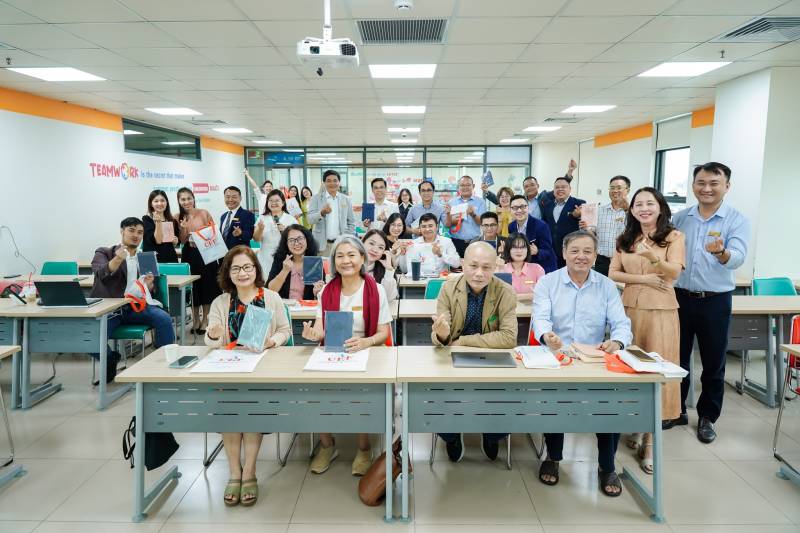
In recent years, particularly in the 2025–2026 academic year, the Faculty of Business Administration (FBA) has achieved comprehensive accomplishments across all areas of operation. In terms of governance and human resource development, the Faculty maintains a stable leadership structure with clear delegation of authority, closely integrating the management of teaching plans, classroom observations, and lecture approvals. The Faculty’s academic staff ensures both quality and quantity, with the participation of international experts and foreign leaders. At the same time, faculty members are continuously developed to enhance their competencies in AI application, research, and teaching methodologies. These efforts are clearly reflected in the very high student evaluation scores for teaching quality (approximately 4.75/5) and the fully completed internal quality document management system, reaching 100%.
In training and scientific research, the Faculty of Business Administration has proactively reviewed three academic programs and developed 21 new instructional materials, closely aligned with trends in digital transformation and modern business practices. Despite managing a large teaching workload—comprising 316 classes, 13,665 teaching hours, and nearly 700 students undertaking graduation internships—the Faculty has consistently maintained a high proportion of students achieving Good, Very Good, and Excellent academic performance. In parallel, research activities have shown strong growth. Faculty members have contributed six international publications (Q1–Q3), 56 domestic articles, along with numerous provincial- and institutional-level research projects. Meanwhile, students have also demonstrated outstanding achievements, securing two ministerial-level research projects, two Eureka awards, and multiple presentations at international conferences.
In terms of external relations and brand development, the Faculty of Business Administration has significantly expanded its partnership network by signing MOUs with more than 50 enterprises and at least three international universities. Leveraging the University’s modern facilities, the Faculty has successfully organized a wide range of activities, including Business Matching programs, internship placements, international exchange programs (in Indonesia, Taiwan, and Japan), and co-teaching classes with international experts. All Faculty activities are consistently communicated through a multi-channel media approach, thereby reinforcing and affirming the Faculty’s image as a dynamic, internationally integrated, and professional academic unit.
Notably, student affairs and community engagement are consistently prioritized by the Faculty of Business Administration, fostering a comprehensive ecosystem that integrates academic, skills-based, cultural, and sports activities. A key highlight is the successful integration of the community service model into formal coursework. Through strong collaboration among faculty members, students, and alumni (Alumni Mentoring) in volunteer and community-based projects, the Faculty has not only exceeded its student affairs targets but also contributed to promoting UEF’s values of sustainable development and social responsibility.
.jpg)
.jpg)
Strengths of the Business Administration program at UEF:
- Students learn in a professional environment that meets international standards;
- Students regularly have the opportunity to interact with successful entrepreneurs and visit real businesses;
- For most subjects, in addition to the official lecturers, successful entrepreneurs in the relevant field are invited as guest speakers to share their practical experience, helping students better understand the real-world application of each subject;
- Beyond academic knowledge, students are also equipped with communication skills, teamwork, presentation skills, and more through Youth Union activities and academic club events;
- Students are especially encouraged to develop their foreign language proficiency and IT skills, enabling them to work confidently at foreign enterprises or pursue advanced studies abroad.
(1)%20(1).jpg)
2. SWOT Analysis
Internal environment analysis
Strengths:
- Position within the UEF ecosystem: The Faculty of Business Administration operates within a university with a clear orientation toward internationalization and digital transformation, having established a strong reputation within the private higher education sector. The quality assurance and accreditation systems provide a solid foundation for the Faculty to enhance its programs and affirm its academic quality.
- Scale and diversity of academic programs: The Faculty of Business Administration oversees multiple programs within the Business and Management discipline, meeting substantial labor market demand (Business Administration, Human Resource Management, Commercial Business, and related fields such as Marketing). This diversity enables the Faculty to maintain flexibility in student recruitment, foster interdisciplinary course development, and optimize the sharing of faculty resources.
- Young, dynamic faculty with strong development potential: The proportion of full-time faculty holding postgraduate qualifications is high, with a growing number of doctoral degree holders. Many faculty members are internationally trained, possess practical industry experience, and are capable of delivering courses in English.
- Strong engagement with industry and the community: The Faculty of Business Administration maintains an extensive network of corporate partners actively involved in the training process (guest lectures, site visits, internships, recruitment, and curriculum review and feedback). At the same time, the Faculty organizes numerous community-based projects and has developed several service-learning courses that integrate community engagement into the student learning experience.
- Strong student engagement and communications: Student clubs, academic competitions, workshops, career events, cultural and sports activities, and volunteer initiatives are organized regularly, attracting broad student participation. The Faculty’s communication channels operate effectively, contributing to brand building and student recruitment.
Weaknesses
- Research capacity and international publications remain limited relative to the Faculty’s scale: Research output is still concentrated among a small number of high-performing individuals, and the number of strong research groups within specialized fields remains limited.
- Uneven adoption of digital transformation and AI: The application of digital transformation and AI in Faculty governance as well as in teaching and learning has not been implemented consistently across courses and among faculty members.
External environment analysis
Opportunities
- Strong demand for high-quality human resources in business and management.
- International integration and labor mobility within ASEAN and globally are driving demand for Business Administration graduates who are capable of working across borders, proficient in English, and equipped with multicultural competencies.
- Government policies on digital transformation, innovation, university autonomy, and entrepreneurship development (e.g., Resolutions No. 29, 71, and national strategies on digital transformation and human resource development for 2021–2030) support the development of Business Administration programs integrating digitalization, sustainability, and internationalization.
Challenges
- Intensifying competition among universities, particularly in Business Administration programs, across tuition fees, brand reputation, facilities, and levels of internationalization.
- Rapidly evolving economic and technological landscape (digital transformation, AI, platform economy, green economy) requires continuous updates of professional knowledge and skills; without timely innovation, curricula risk becoming outdated relative to market demands.
- Increasing requirements from national and international accreditation bodies regarding faculty qualifications, research output, industry and international collaboration, and quality assurance systems.
- Rising expectations from students and parents in terms of teaching quality, learning experience, support services, international environment, scholarships, and employment opportunities.
Faculty of Business Administration, UEF


