



Research
Two Perspectives on Adaptability: ESG, Geopolitical Risk, and Digital Financial Capability
01/10/2026






As the global economy simultaneously faces geopolitical uncertainty, growing sustainability requirements, and an accelerating pace of digitalisation, adaptability is becoming an increasingly important issue at both the corporate and individual levels. From this perspective, two studies published in 2026 by lecturers from the UEF Faculty of Finance and Accounting examine this issue from two different angles, ranging from corporate resilience to geopolitical risk to individual sustainable financial capability in a digital environment.
The first study, “Does ESG shield firm value from geopolitical risk? Evidence from Asian markets”, focuses on clarifying the relationship between geopolitical risk, ESG performance, and firm value across Asian markets. The authors, Lam Thanh Nguyen and Phung Dinh Tran, use data from listed non-financial firms in Asian economies over the 2000 - 2024 period to examine whether stronger ESG performance can help firms preserve their value in the face of shocks arising from the geopolitical environment.
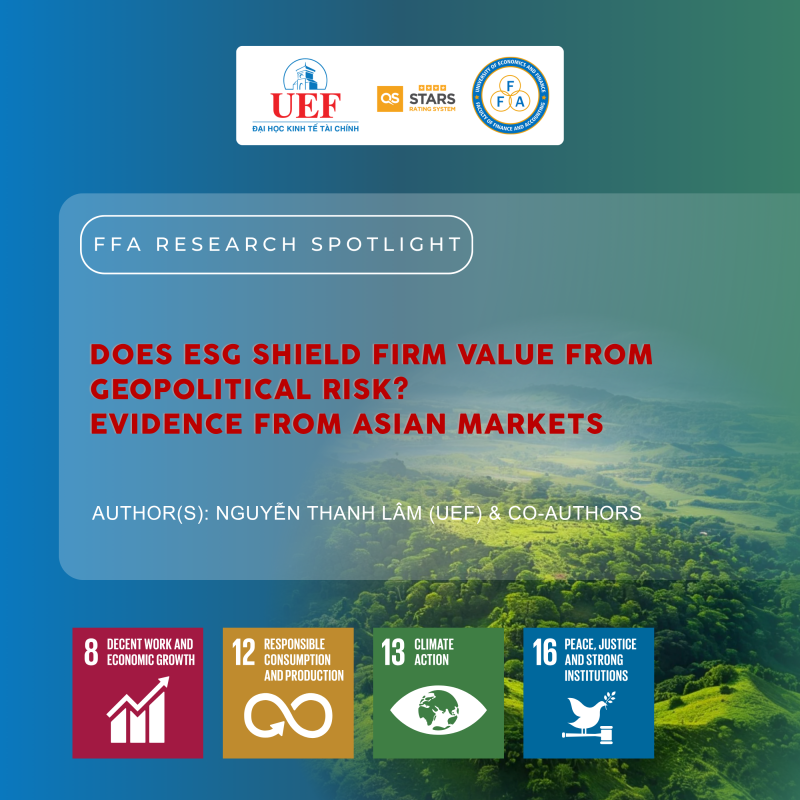
The study analyses the role of ESG in strengthening the resilience of firm value to geopolitical risk across Asian markets
The findings show that geopolitical risk is negatively associated with firm value. As geopolitical uncertainty increases, corporate valuations tend to face adverse effects. However, this relationship becomes weaker among firms with stronger ESG performance. This finding suggests that ESG may be associated with a firm’s ability to preserve value and strengthen resilience when facing shocks from the external environment.
Another notable finding is that the three ESG dimensions do not play identical roles. The results indicate that the Social and Governance pillars demonstrate a clearer moderating role than the Environmental pillar. At the same time, the effects of ESG also vary according to industry, firm size, ownership structure, and the level of financial market development.
From a corporate governance perspective, these findings broaden the way ESG can be understood. ESG is associated not only with long-term sustainability commitments but can also be considered in relation to risk management, stability, and corporate adaptability in the face of increasingly unpredictable changes in the international business environment.
While the first study examines adaptability at the corporate level, the second shifts the focus to individuals in the context of digital finance. The study “Financial behaviour translates digital literacy financial knowledge and financial attitude into sustainable financial capability in Vietnam” by Minh Tu Tran and Marie Paseková asks an important question: as digital banking, mobile payments, and financial applications become increasingly widespread, are financial knowledge and the ability to use technology sufficient for individuals to develop sustainable financial capability?

The study clarifies how financial knowledge, financial attitudes, and digital literacy are translated into sustainable financial capability through financial behaviour
Based on a survey of 402 adults in Vietnam with experience in financial activities and digital financial services, the study finds that financial knowledge, financial attitudes, and digital literacy are all positively associated with financial behaviour. Among the factors examined, financial knowledge has the strongest impact on financial behaviour.
A key contribution of the study lies in the central role of financial behaviour. Knowledge or technological proficiency creates meaningful value only when it is translated into specific practices such as budgeting, financial planning, transaction monitoring, and risk management. Accordingly, financial behaviour serves as the bridge between what an individual “knows” and their actual ability to manage financial resources responsibly and sustainably.
This finding also offers an important perspective on the digital transformation of the financial sector. Access to digital platforms or proficiency in using technology does not automatically translate into stronger financial capability. What matters is whether users can convert their knowledge and digital tools into appropriate financial decisions and behaviours in practice.
Taken together, the two studies reveal an important common point: possessing resources alone is not sufficient to create adaptability. At the corporate level, ESG can generate meaningful value when it is integrated into governance and risk-response capabilities. At the individual level, financial knowledge and digital literacy translate into genuine capability only when they are transformed into appropriate financial behaviours.
The two studies therefore contribute to broadening the discussion of sustainable development across two distinct levels. Sustainability is associated not only with long-term commitments or access to resources, but also with the ability to transform resources into action and maintain adaptability in the face of change. These research directions are becoming increasingly significant for the fields of finance and accounting amid heightened global economic volatility and the rapid pace of digital transformation.
Faculty of Finance and Accounting
RELATED NEWS